
Master the PTE Academic Test: Your Ultimate Guide to Smarter Prep, New Formats, and High Scores

Preparing for an English proficiency test can feel like climbing an uphill battle. If you need a globally recognized score for university admissions, professional registration, or visa applications, the Pearson Test of English (PTE Academic) is your fastest route. Known for its computer-based precision and lightning-fast results (usually within 48 hours), the PTE is trusted by thousands of institutions worldwide.

Whether you are starting from scratch or looking to push your score past the coveted 79-point mark, this guide breaks down everything you need to know about the exam format, current updates, and winning preparation strategies.

Understanding the PTE Exam Format

The PTE Academic exam is split into three main timed sections, encompassing 22 distinct question types designed to test how naturally and accurately you use English in real-world academic environments.

1. Speaking & Writing

(Approx. 76–84 Minutes)

This combined section kicks off the test. It evaluates your spoken fluency, pronunciation, and written English.

  • Core Tasks: Read Aloud, Repeat Sentence, Describe Image, Re-tell Lecture, and Essay Writing.
  • Latest Updates: Pearson introduced two dynamic tasks—Summarize Group Discussion and Respond to a Situation. These additions assess spontaneous, everyday communication rather than rigid, memorized templates.

2. Reading

(Approx. 23–30 Minutes)

Short, sharp, and focused, the reading section tests your ability to comprehend academic texts, identify vocabulary in context, and navigate logical structures.

  • Core Tasks: Fill in the Blanks (Drag-and-Drop and Drop-Down), Multiple-Choice Questions, and Re-order Paragraphs.

3. Listening

(Approx. 29–36 Minutes)

Driven by audio and video clips, this module evaluates your capability to follow spoken English across various accents and academic lecture settings.

  • Core Tasks: Summarize Spoken Text, Fill in the Blanks, Highlight Incorrect Words, and the high-weightage Write from Dictation.
Smiling woman at a desk looking at a laptop showing a PTE score report of 84 beside explanatory text on PTE scoring.

How the PTE Scoring System Works

One of the greatest advantages of the PTE exam is its objective grading methodology.

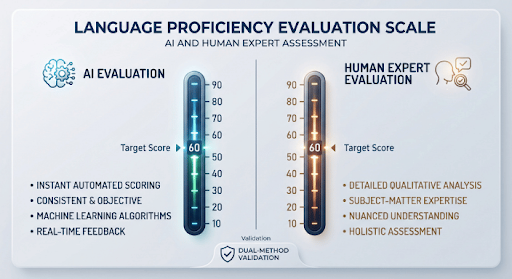
  • The 10–90 Scale: Your performance is mapped across an overall score range of 10 to 90 points, aligned directly with the Global Scale of English (GSE) and the Common European Framework of Reference for Languages (CEFR).
  • Hybrid AI + Human Evaluation: While advanced AI algorithms analyze your pronunciation, fluency, and syntax with absolute impartiality, selected tasks—such as essay writing and summaries—receive secondary human expert reviews for content and structure. This hybrid model guarantees both speed and deep linguistic fairness.

Proven Strategies to Crush Your PTE Goal

Stop wasting hours studying harder instead of smarter. Implement these high-yield tactics to secure your dream score:

  • Ditch Rigid Templates: The modern PTE scoring system heavily penalizes robotic, over-used template responses in speaking and writing. Focus on natural phrasing, clear pauses, and authentic delivery.
  • Master “Write from Dictation”: Located at the very end of the listening module, this single task carries massive weight for both your Listening and Writing scores. Practice daily sentence-dictation drills to master spelling and retention.
  • Simulate Real Test Conditions: Take full-length timed mock tests using digital platforms that mirror the actual Pearson interface. Building exam-day stamina is just as important as vocabulary building.
  • Target High-Yield Modules: Prioritize tasks that feed points into multiple skills (like Read Aloud for Reading and Speaking, or Write from Dictation for Listening and Writing).

Ready to Transform Your English Proficiency?

Passing the PTE test isn’t about memorizing every dictionary word—it’s about understanding the blueprint of the exam and aligning your communication skills with what the scoring engine expects.

Begin by taking a baseline diagnostic mock test today to identify your weak spots, build a structured study calendar, and step into the test center with total confidence.