
Conquer the PTE Academic Exam: The Definitive Guide to the Modern Test Format and Smart Preparation

Navigating the journey toward global education, career migration, or professional registration often hinges on a single, crucial milestone: proving your English language proficiency. Among the choices available, the PTE Academic test stands out for its high-speed turnaround, digital accuracy, and global recognition.

Designed to reflect real-world academic and everyday environments, the test format features 22 distinct question types spread across a streamlined, roughly two-hour session. Whether you are aiming for a baseline competent score or pushing for a superior 79+ mark, understanding the nuances of the exam structure is your key to success.

The 3 Pillars of the PTE Academic Test

The exam is structured into three continuous, computer-delivered sections designed to test how naturally you integrate language skills:

1. Speaking & Writing

(Approx. 76–84 Minutes)

This is the longest part of the test, evaluating your command of spoken and written English.

  • Core Tasks: Read Aloud, Repeat Sentence, Describe Image, Re-tell Lecture, Answer Short Question, Summarize Written Text, and Write Essay.
  • Real-World Additions: Pearson integrates tasks like Summarize Group Discussion (listening to a multi-speaker exchange and synthesizing the core takeaways) and Respond to a Situation (reacting verbally to a practical, real-life prompt). These components measure spontaneous fluency rather than rehearsed robotic templates.

2. Reading

(Approx. 23–30 Minutes)

Short, dynamic, and intensive, this module measures your ability to parse, comprehend, and logically order academic text.

  • Core Tasks: Fill in the Blanks (Drag-and-Drop and Drop-Down), Multiple-Choice Questions, and Re-order Paragraphs.

3. Listening

(Approx. 29–36 Minutes)

Anchored by audio and video clips covering various global accents, this section tests how well you follow spoken English.

  • Core Tasks: Summarize Spoken Text, Fill in the Blanks, Highlight Incorrect Words, and the high-value Write from Dictation task.

Decoding the Hybrid Scoring Engine

One of the reasons test-takers prefer PTE Academic is its transparent 10 to 90 score scale, which maps cleanly against the Global Scale of English (GSE) and CEFR levels.

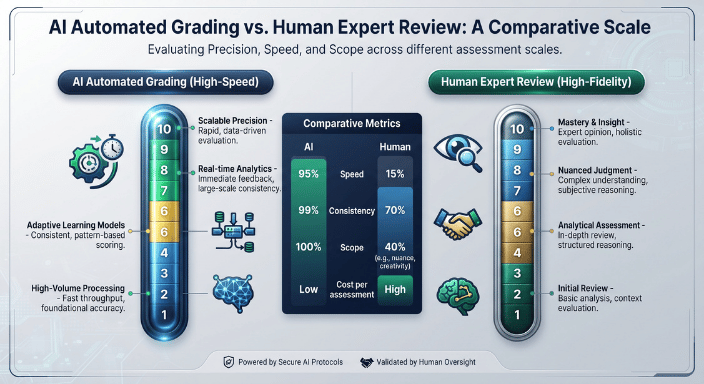
  • Advanced AI Evaluation: Cutting-edge speech-recognition algorithms evaluate your pronunciation, pitch, oral fluency, and grammatical structure with absolute objective impartiality.
  • Human Expert Review: To ensure absolute fairness and accuracy, open-ended tasks (such as essays, summaries, and complex spoken responses) undergo secondary review by human experts who evaluate content relevance, logic, and structural cohesion.

Smart Strategies to Maximize Your Score

Generic memorization no longer works on modern English tests. If you want to outperform the average candidate, adopt these high-yield study principles:

  • Prioritize Natural Delivery: Over-reused, robotic templates are easily detected by modern scoring metrics. Practice speaking with natural cadences, standard stress patterns, and clear structural transitions.
  • Master High-Weight Tasks: Focus extra energy on tasks that feed scores into multiple skill areas—such as Write from Dictation for listening and writing, or Read Aloud for reading and speaking.
  • Build Digital Stamina: Because the test runs continuously without scheduled breaks, train with full-length computer mock tests to condition your focus and time management under pressure.

Take the Next Step Toward Your Global Goals

Achieving your target PTE score is entirely possible with the right blueprint, consistent practice, and a focus on authentic communication skills rather than shortcuts. Evaluate your current baseline with a timed diagnostic test today, structure your daily study habits, and walk into the testing center ready to succeed.