
IELTS Academic: Navigating the Standard for Higher Education and Professional Registration

If your sights are set on gaining admission to a global university, enrolling in postgraduate research, or pursuing professional registration with a strict medical or engineering board, the IELTS Academic test is your benchmark.

Designed specifically to evaluate whether you are ready to handle complex English in an academic or higher-education environment, this version tests your ability to parse scholarly journals, listen to complex lectures, and articulate analytical arguments with precision.

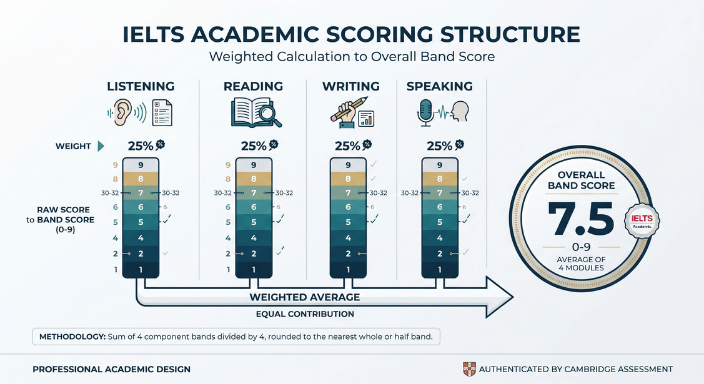
The 4 Core Sections of IELTS Academic

The test spans roughly 2 hours and 45 minutes, broken down into four distinct sections:
1. Listening

(Approx. 30 Minutes)
  • What you do: Listen to four recorded audio tracks—ranging from everyday social conversations to academic lectures—and answer 40 questions.
  • What it tests: Your capacity to follow main ideas, recognize opinions, and capture detailed factual information.

2. Reading

(60 Minutes)
  • What you do: Read three long, authentic texts sourced from books, scholarly journals, magazines, and newspapers, answering a total of 40 questions.
  • What it tests: Advanced comprehension skills, including following logical arguments, recognizing a writer’s underlying attitude, and analyzing factual or discursive themes.

3. Writing

(60 Minutes)
  • Task 1: You are given a graph, table, chart, or diagram and must summarize, describe, or explain the data in at least 150 words (recommended time: 20 minutes).
  • Task 2: You must write a formal, structured essay of at least 250 words in response to an academic point of view, argument, or problem (recommended time: 40 minutes).

4. Speaking

(11 to 14 Minutes)
  • What you do: A face-to-face or high-definition video interview with a certified examiner split into three parts: general introductory questions, a structured individual long-turn talk (cue card), and a deeper analytical discussion.

Key Strategies for Success in IELTS Academic

  • Ditch the Memorized Templates: Examiners and modern evaluation frameworks instantly penalize robotic, unnatural paragraphs. Focus on natural lexical variety and logical argument development.
  • Master Academic Register: Ensure your Writing Task 1 descriptions remain objective, formal, and focused on major trends rather than minor visual clutter.